
Insight Report

Sixty Years in the Room: The Gap Runs Both Ways (Australian Edition)

Download the Insight Report

An Australian workplace can now span sixty years. The research finds the differences across it trivial to small.

‍

Gen Alpha's oldest turn 16 this year, and people are still working into their mid 70s. The gaps people describe across that span are real. The observation made about Gen Z today was made about Millennials in 2013, Gen X in 1990 and the Boomers in 1976, in close to the same words.

‍

Two meta-analyses, one pooling more than 158,000 people, found generational differences at work trivial to small. So something else is doing the work. In an Australian workplace, age and seniority are close to the same variable, and from the floor it's hard to say whether age or rank is doing the work.

‍

This is a six-page white paper, a 10-minute read, written for HR, people and L&D leaders working out how to lead, develop and keep a workforce that spans sixty years. Written by Graham Dobbin, Director of Dale Carnegie Australia, Workplace Strategy and Change Leadership.
Is the generation gap at work real?

Partly. The differences people describe are real to them, but much of what reads as age is actually seniority.

‍

Two meta-analyses, one of 20 studies pooling 19,961 people (Costanza et al, 2012) and one of 143 samples covering more than 158,000 (Ravid et al, 2024), both found generational differences at work trivial to small. That is a long way from how it feels on the ground.

‍

The reason is who sits where. Millennials and Gen X hold 75.6% of Australian management between them, and managers under 30 are down to 9.4%. The OECD finds managers older than the people reporting to them in every country it has looked at. So somebody describing a generational difference is describing something real. From where they stand, the older person and the more senior one are the same person.

Inside the paper

The span.

Four generations at work and a fifth arriving, and why two of them hold three quarters of Australian management.

The way in.

Why 16 year olds may be starting work earlier than they have in thirty years, and what a degree now costs against what it returns.

The thinning middle.

Management grew 21.6% in a decade. Managers under 30 went backwards, and nobody has asked them why.

What retains people.

Four assumptions that cost money, the gap between what people ask for and why they leave, and four things that move people once pay is competitive.

Why now

‍

The span is at its widest. Gen Alpha's oldest can legally work from this year, while the share of Australians aged 70 to 79 still working has risen in a decade, from 11% to 14% for men and 5% to 9% for women. Years in retirement have roughly doubled. The money to pay for them has not.

‍

The layer expected to hold all of this together is stretched. Teams have grown by close to half since 2013, a median manager spends 40% of their time on work that has nothing to do with managing, and more than half of Australian organisations have never trained a line manager to lead across an age gap. Every practical answer gets delivered by that person, in what is left of the week.

‍

‍

Key numbers and ideas

178,000

Australian managers under 30, down from 187,000 a decade ago while total management grew 21.6%

10.4×

how much more strongly a toxic culture predicted people walking out than their pay did

Everybody at work has been the youngest person there, and been described as a problem for it.

Knowledge has never been cheaper. Acting on it is the whole job.

About the research

The paper draws on the Australian Bureau of Statistics Labour Force, Detailed, table EQ13 (February 2016 and February 2026), for manager counts by age; ASFA's superannuation balance update (October 2025, using ATO data); KPMG's analysis of ABS Labour Force data (September 2025); QILT's 2024 Graduate Outcomes Survey Longitudinal (42,399 responses across 126 institutions); two meta-analyses of generational differences at work, Costanza et al (2012, 19,961 people) and Ravid, Costanza and Romero (2024, more than 158,000 people); McKinsey's Gen What? (2023, 13,386 workers across six countries including Australia); MIT Sloan Management Review (2022, 34 million employment profiles); Gallup's Workforce Study (May 2025, 19,043 US adults); AHRI and the Australian Human Rights Commission (2025, 148 HR professionals); and Dale Carnegie's Bridging the Gaps (published January 2025, 3,375 respondents across 18 countries). Generational years follow McCrindle Research throughout. Written by Graham Dobbin, Director of Dale Carnegie Australia, Workplace Strategy and Change Leadership. Full citations are listed in the paper.
About Dale Carnegie

Dale Carnegie has been studying what changes how people communicate, lead and influence at work since 1912. That work now runs in 85+ countries and 35 languages, with more than 430 of the Global Fortune 500, and Dale Carnegie has been named a Top 20 leadership training company every year since 2016. In Australia, we work with HR, people and commercial leaders at organisations including Toshiba, NEXTDC, Cartier, Montblanc and Mazars to turn capability frameworks into behaviour that shows up in the actual work, in the week after the training.

Download the
Insight Report

By submitting this form you agree to our Privacy Policy.
Thank you! Your submission has been received!
Oops! Something went wrong while submitting the form.
How many generations are in the Australian workforce?

Four, with a fifth arriving. Gen Alpha's oldest turn 16 in 2026, and people are still working into their mid 70s.

‍

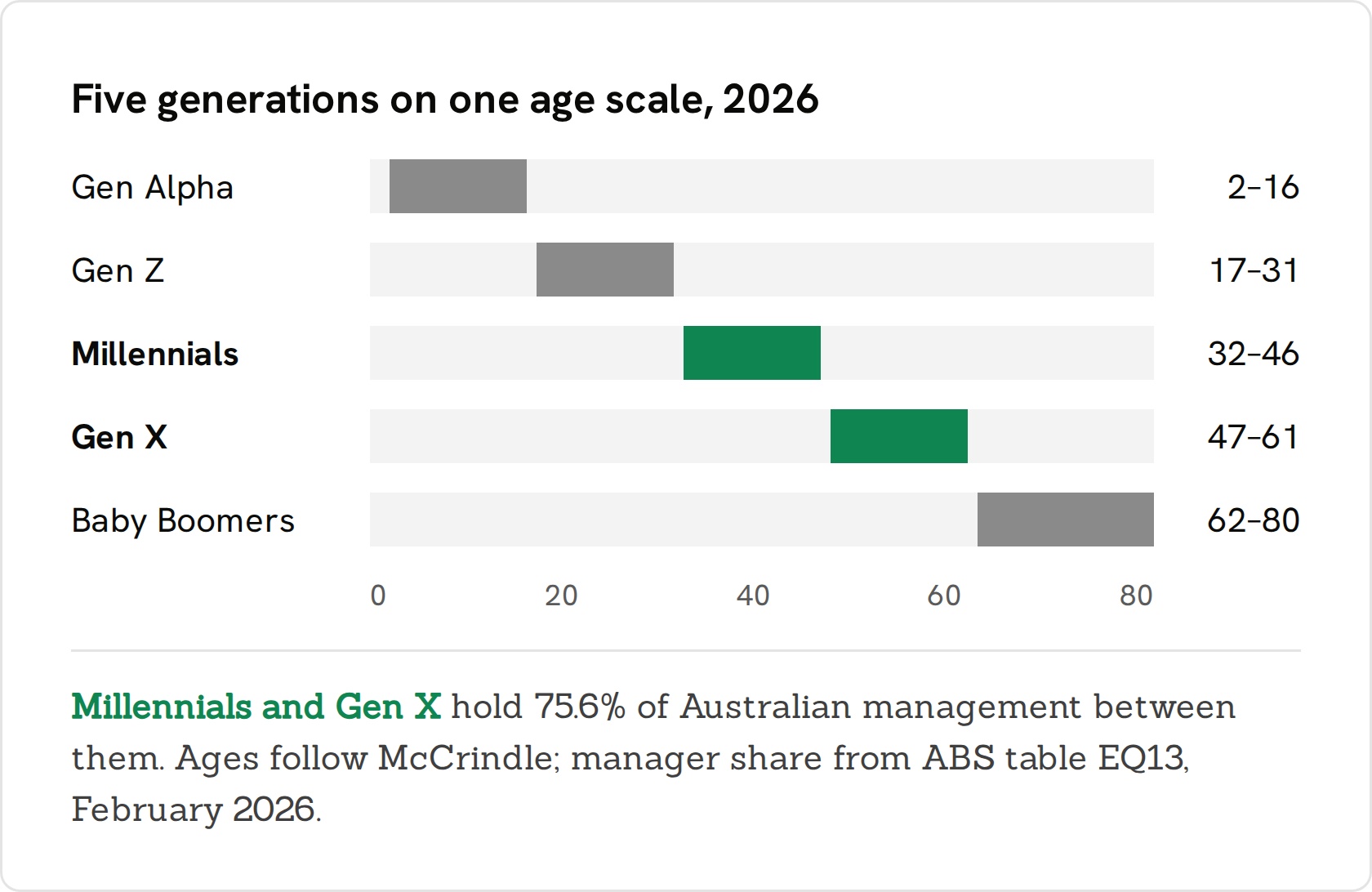
On McCrindle's fifteen-year cadence, the workforce runs from Gen Alpha (born 2010 to 2024) and Gen Z (1995 to 2009, now 17 to 31) through Millennials (1980 to 1994, 32 to 46) and Gen X (1965 to 1979, 47 to 61) to Baby Boomers (1946 to 1964, 62 to 80).

‍

Management sits in the middle. ABS figures for February 2026 count 728,000 managers aged 45 to 59 and 706,000 aged 30 to 44, against 283,000 aged 60 and over and 178,000 under 30. Millennials and Gen X hold 75.6% of Australian management between them.

‍

The boundaries don't cut cleanly. In March 2020 the oldest of Gen Z was 25 and in some cases already running a shift, while the youngest was 10 and in Year 5. People either side of the lines now call themselves Zillennials and Zalphas, which is a fair sign the official labels don't fit.

Why are there fewer young managers in Australia?

Nobody has measured why. The count is clear: managers under 30 fell from 187,000 to 178,000 in the decade to February 2026, while total management grew 21.6%.

‍

Their share of all managers dropped from 12.0% to 9.4%. No Australian survey asks employees directly whether they want to manage, and the APS Employee Census, the largest in the country, doesn't carry the question.

‍

The paper offers three explanations, as opinion. The bottom rung may have gone, with the work that gave people a first taste of running things now automated or absorbed. The reward may no longer cover the effort, given what the role visibly costs the people doing it. Or the job now asks for what this cohort has had least practice at: the difficult conversation, reading a room, influence without authority.

‍

That last one matters. Australian research tracking 4,704 people aged 15 to 19 found verbal communication predicted later employment and wages (Forrest and Swanton, 2021).

What actually retains employees across generations?

Not pay, once pay is competitive. Culture and leadership predict who leaves far more strongly, and that holds in every age group.

‍

Asked what matters, 46% of workers name compensation, ahead of career development (36%), meaningful work (35%) and flexibility (34%). It ranks the same in every age group (McKinsey, 2023, 13,386 workers across six countries including Australia).

‍

Behaviour tells a different story. A toxic culture predicted people walking out 10.4 times more strongly than pay did (MIT Sloan, 2022, 34 million employment profiles). Pay explains about 2% of the difference in job satisfaction between one person and another (Judge et al, 2010). And in Glassdoor's 2019 research across five countries, pay and benefits came last in shaping how people rated their employer, behind culture and senior leadership.

‍

Herzberg described this gap in 1959 and Google found it again in 2015. What does predict staying is the need to feel necessary, and it is the same at 23 as it is at 58.

What do leaders get wrong about younger and older workers?

Four common assumptions don't hold up, and each one costs money when it drives a decision.

‍

• "They bought property. They are sorted." Median super at 60 to 64 is $189,618 against a $630,000 target, and around three in ten retire with enough (ASFA, October 2025).

‍

• "Gen Z want to work from home." They are the least keen on fully remote of any generation, 23% against 35%, and only 6% want to be fully on site (Gallup, May 2025, US).

‍

• "Older workers are winding down." Australians aged 70 to 79 still working went from 11% to 14% for men and 5% to 9% for women in a decade (KPMG analysis of ABS data, September 2025).

‍

• "The youngest are the most cynical about leadership." Trust in leadership's AI decisions sits at 25% for Gen Z, 21% for Gen X and 8% for Boomers (Dale Carnegie, 2025, 3,375 respondents across 18 countries).

How do you lead a multigenerational team?

Pay competitively, then put the effort where it moves people. Four moves, two of which cost nothing but attention.

‍

1. Make people visibly necessary. Every manager finishes one sentence about each of their people: if this person left on Friday, the thing that would break is ___. If they can't finish it, that is the work. If they can, the person needs to hear it.

‍

2. Design the connection instead of hoping for it. Two thirds of the youngest employees pick their own office days, so they turn up to an empty room. Set the days a team is in together, say what they are for, and make them worth the commute. Anchor days beat attendance targets.

‍

3. Give the manager room to manage. 40% of a median manager's time goes on work that has nothing to do with managing. Have every manager log a fortnight and mark the work only they could have done. The rest can be removed, automated or handed on.

‍

4. Teach people to lead across an age gap. More than half of Australian organisations have never trained a line manager to do it. Name the capabilities (the difficult conversation with somebody 30 years older or younger, reading a room, influencing people who report to someone else) and teach them on the organisation's own situations.

‍