
Insight Report

Sixty Years in the Room: The Gap Runs Both Ways (Global Edition)

Download the Insight Report

A workplace can now span sixty years. Much of the gap people put down to age is about rank.

‍

A workplace can now hold somebody of 16 and somebody past 70. The gaps people describe across that span are real. There is a second gap too, between the newest person in the building and the most senior, and from the floor it's hard to say whether age or rank is doing the work.

‍

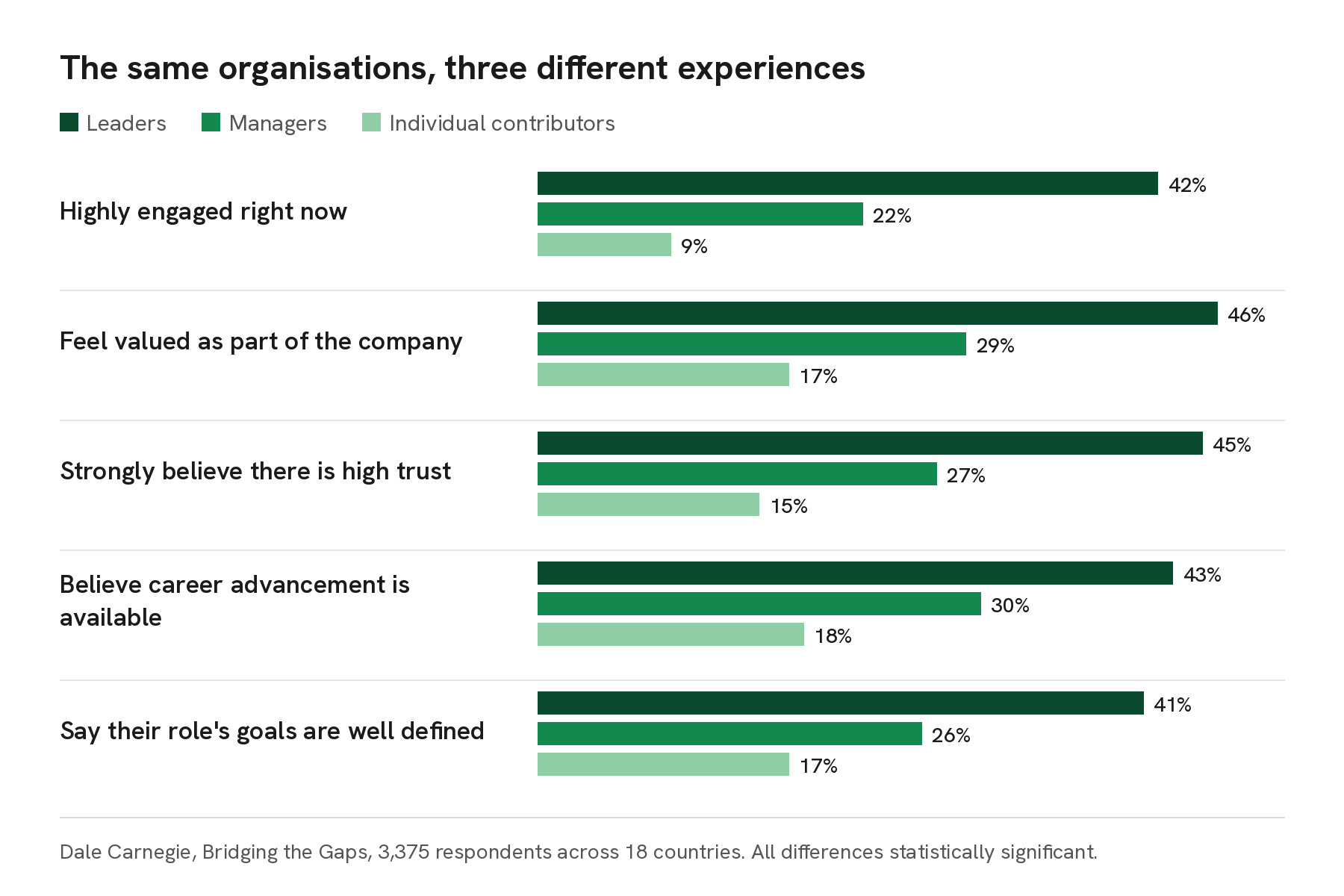
Dale Carnegie surveyed 3,375 people across 18 countries and cut the results by where somebody sits rather than when they were born. 42% of leaders describe themselves as highly engaged, against 22% of managers and 9% of individual contributors. The pattern held on every topic tested.

‍

This is a six-page white paper, a 9-minute read, written for HR, people and L&D leaders working across markets. Written in Sydney by Graham Dobbin, Director of Dale Carnegie Australia, Workplace Strategy and Change Leadership. The research spans 18 countries, because what it describes does not stop at a border.
Is the generation gap at work real?

The friction is real, but the measured generational effect is trivial to small. Something else is doing most of the work.

‍

Costanza and colleagues pooled 20 studies covering 19,961 people and concluded that meaningful differences among generations probably do not exist. Ravid, Costanza and Romero reviewed 406 articles and pooled 143 samples covering more than 158,000 people, and found effect sizes trivial to small. Even so, 69% of those 406 studies issued generation-based recommendations anyway.

‍

People don't fully accept the label either. YouGov asked 13,038 adults and found that among everyone born since 1981, roughly four in ten identify with the generation assigned to them. Those born nearest the boundaries identify least, which is why Zillennials and Zalphas have started to appear.

Inside the paper

The labels.

Why the difference everyone can see is so hard to measure, and why most people born since 1981 don't identify with their own generation.

Age and seniority.

Leaders are older than the people they lead in every market anyone has checked. Dale Carnegie's data separates the two.

The common ground.

The two things that predicted engagement and intention to leave for every role, in every model.

What retains people.

What people ask for against why they actually leave, and four things that work at every level and every age.

Why now

‍

The span is at its widest. Four generations are already at work and Gen Alpha's oldest reach working age this year. At the top, the distance keeps growing: average CEO age rose by roughly ten years between 2000 and 2023, to 61, and the age at which somebody is handed the job moved from 47 to 55.

‍

Most of the answer sits with one layer. Managers report 22% engagement, only 30% believe advancement is available where they work, and they are the people expected to make everyone else feel valued and keep communication working. That cannot be fixed by a policy. It is fixed by a manager.

‍

Key numbers and ideas

33 points

between leaders and individual contributors on engagement, in the same organisations across 18 countries

50% v 26%

leaders who strongly understand the company's current goals, against individual contributors

Two people the same age, in the same company, one level apart, are having completely different experiences of it.

The message is going out. It is stopping somewhere on the way down.

About the research

The paper draws on Dale Carnegie's Bridging the Gaps: Aligning Workplace Perceptions Across Organizational Levels (Robert Coleman PhD, published January 2025, 3,375 respondents across 18 countries, analysis conducted 2024), the source for every figure by role and for the predictive models of engagement and turnover intention; OECD and AARP, Promoting an Age-Inclusive Workforce (2020); NBER Working Paper 35089 (2025, 50,510 chief executives in the United States and 17,962 across 18 European countries); Eurostat (13.6 million managers across the EU28); two meta-analyses of generational differences at work, Costanza et al (2012, 19,961 people) and Ravid, Costanza and Romero (2024, more than 158,000 people); YouGov (2024, 13,038 adults); McKinsey's Gen What? (2023, 13,386 workers across Australia, Canada, India, Singapore, the UK and the US); Judge et al (2010, 18,460 people); and Glassdoor Economic Research (2019, five countries). Generational years follow McCrindle Research throughout. Written in Sydney by Graham Dobbin, Director of Dale Carnegie Australia, Workplace Strategy and Change Leadership. Full citations are listed in the paper.

About Dale Carnegie

Dale Carnegie has been studying what changes how people communicate, lead and influence at work since 1912. That work now runs in 85+ countries and 35 languages, with more than 430 of the Global Fortune 500, and Dale Carnegie has been named a Top 20 leadership training company every year since 2016. We work with HR, people and commercial leaders at organisations including Toshiba, NEXTDC, Cartier, Montblanc and Mazars to turn capability frameworks into behaviour that shows up in the actual work, in the week after the training.

Download the
Insight Report

By submitting this form you agree to our Privacy Policy.
Thank you! Your submission has been received!
Oops! Something went wrong while submitting the form.
Is it age or seniority that divides a workplace?

Often seniority. Age and rank travel together, so from the floor the two are hard to tell apart.

‍

The OECD found the chief executive older than the median employee at every level of firm productivity, and managers older than the people reporting to them, in Costa Rica, Finland, Hungary, Japan and Germany alike.

‍

The distance is widening. Across 50,510 American chief executives and 17,962 European ones, average CEO age rose by roughly ten years between 2000 and 2023, to 61. The college-educated workforce aged about a fifth as fast, and the age at which somebody is handed the job moved from 47 to 55.

‍

So somebody describing a generational difference is describing something real. They may have the cause slightly wrong.

How does employee engagement differ by role?

Sharply. 42% of leaders describe themselves as highly engaged, against 22% of managers and 9% of individual contributors.

‍

Dale Carnegie's survey of 3,375 people across 18 countries found the same split on every topic tested. Feeling valued runs at 46%, 29% and 17%. Trust at 45%, 27% and 15%. Belief that career advancement is available at 43%, 30% and 18%.

‍

Even goal achievement, which ought to be a matter of fact, splits the same way. Asked whether their team exceeded its goals last year, 45.2% of leaders said yes, against 25% of individual contributors.

‍

That is 33 points between a leader and an individual contributor on engagement. Two people the same age, in the same company, one level apart, are having completely different experiences of it.

What drives engagement and retention at every level?

Two things, for every role in every model: feeling valued as part of the company, and the quality of communication.

‍

After that the drivers diverge, and they diverge by role rather than by age. For managers, the unique driver was career advancement. For individual contributors, it was believing their work contributes to the company's success. For leaders, it was understanding the company's goals.

‍

McKinsey found the same shape from the other direction. Across 13,386 workers in six countries, employees of all ages wanted largely the same things and left for largely the same reasons.

Does pay keep employees?

Pay has to be competitive. Once it is, it stops moving anybody.

‍

Asked what matters, 46% of workers name compensation first, ahead of career development (36%), meaningful work (35%) and flexibility (34%), and the ranking holds in every age group (McKinsey, 2023).

‍

Behaviour says something else. Pay accounts for about 2% of what makes one person more satisfied at work than another (Judge et al, 2010, 18,460 people). In Glassdoor's 2019 research across five countries, pay and benefits mattered least to how people rated their employer, behind culture and senior leadership. Feeling valued, by contrast, drove both engagement and intention to leave in every Dale Carnegie model, at every level.

‍

Herzberg described this gap in 1959 and Google found it again in 2015. None of which says pay doesn't matter: anyone paying under the market loses people whatever else they do.

How do you lead a multigenerational team?

Four moves that work at every level and every age. Two of them cost nothing but attention.

‍

1. Make people visibly necessary. Feeling valued predicted engagement and intention to leave for every role. Every manager finishes one sentence about each of their people: if this person left on Friday, the thing that would break is ___. If they can't finish it, that is the work. If they can, the person needs to hear it.

‍

2. Measure whether the message lands. 50% of leaders strongly understand the company's current goals, against 26% of individual contributors. Ask three people two levels down to describe the strategy in their own words. The gap between their answer and the deck is the real number.‍

‍

3. Give managers something to offer. Only 30% of managers believe advancement is available where they work, yet they are asked to develop everybody below them. Every manager should be able to name the next two roles they could credibly hold and what stands between them.

‍

‍4. Teach people to lead across an age gap. Name the capabilities (the difficult conversation with somebody 30 years older or younger, reading a room that shares none of the same references, influencing people who report to someone else) and teach them on the organisation's own situations.

‍