Critical Thinking: The Capability We Skipped
Register now



Maybe it came up over dinner. A friend’s son or daughter has been applying for jobs for months and hearing nothing back. Or you read another headline about AI and entry-level work and wondered what it means for a teenager who’s still finishing school.
If that’s been on your mind, plenty of other parents feel the same. 63% of Australian parents say they’re concerned about their children’s future job security, according to Real Insurance’s Real Jobs of the Future 2026 report.
Young people feel it too, though not about the tools themselves. Gen Z are among the most confident AI users at work. What worries them is the way in. In the Hatch Hotlist 2026, 81% said they're concerned AI will reduce or remove junior and early-career roles.
Despite that worry, 84% of young Australians feel optimistic about their career growth, according to the same Hatch research. It’s up from 75% in 2024. That optimism is worth backing with a clear picture of what’s actually going on.

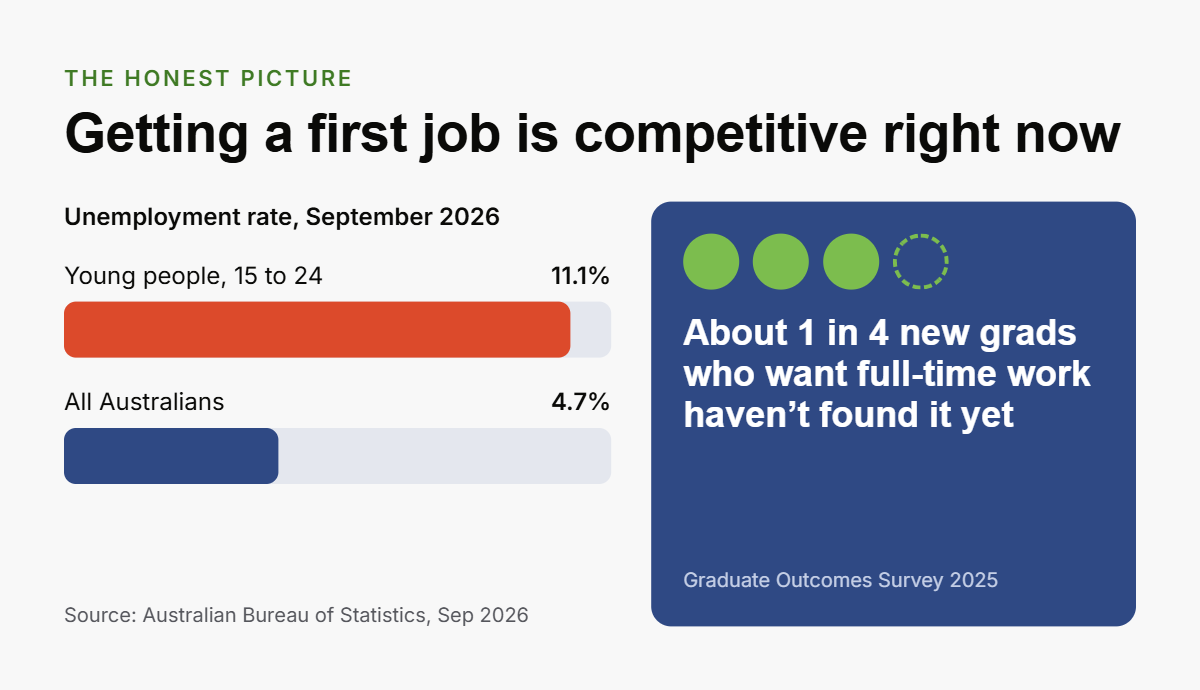
The honest answer first. Getting a first job is competitive right now. In September 2026, youth unemployment (ages 15 to 24) sat at 11.1%, according to the Australian Bureau of Statistics. That’s more than double the overall rate of 4.7%.
A degree helps, but it doesn’t guarantee a quick start. The Graduate Outcomes Survey 2025 found 75.4% of new undergraduates looking for full-time work had found it 4 to 6 months after finishing. That’s up a little on 74% the year before, though the survey says the rise is likely down to a change in how it defines the labour force. Either way, about 1 in 4 who want full-time work haven’t found it yet.
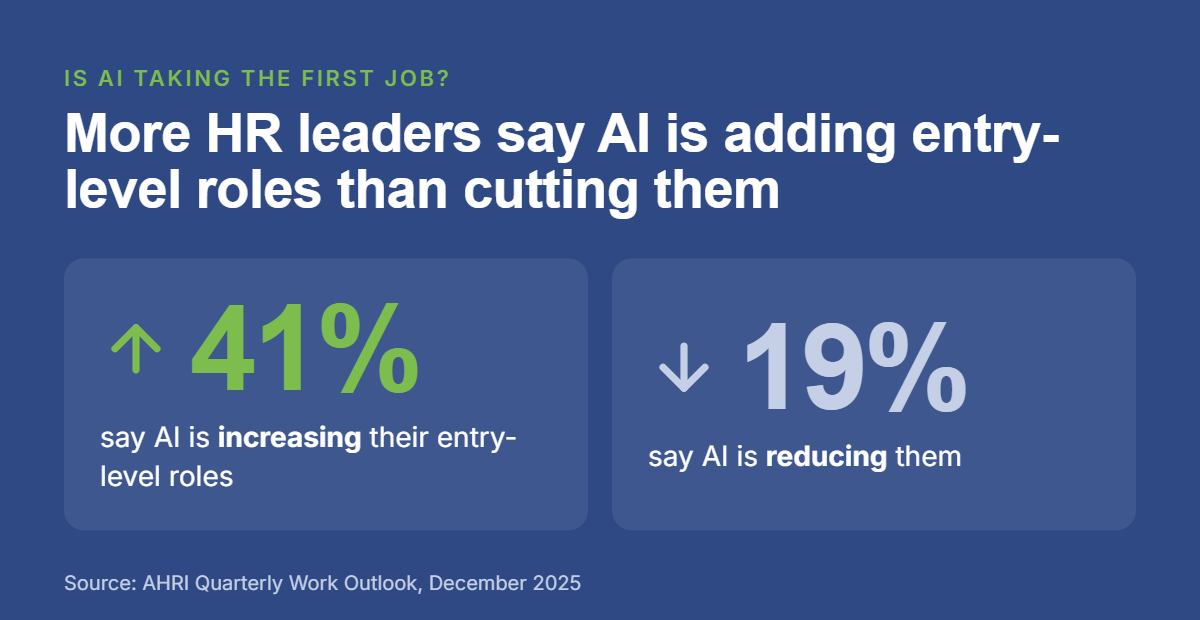
Here's where it gets less clear-cut. Young people expect AI to shrink entry-level jobs, but many employers are reporting the opposite. In AHRI’s December 2025 Quarterly Work Outlook, 41% of Australian HR leaders said AI is increasing the number of entry-level roles at their organisation. Only 19% said it's reducing them.
Government research points the same way. Jobs and Skills Australia's Our Gen AI Transition report found generative AI is more likely to take over parts of a job than the whole thing.
So the first job is still there. What it asks of young people is shifting. Employers are still figuring out exactly how, but they keep pointing to the same few things.
Employers say they'll expect more from new starters than they used to. Some of that is experience, and it doesn't have to mean a job. Leading a team, running a club or getting up on stage all count. The rest is judgement, critical thinking, communication and initiative, according to the 152 employers surveyed for the Hatch Hotlist 2026.
The good news is employers already see a lot in young people. In the AHRI and Australian Human Rights Commission’s Older and Younger Workers Report 2025, HR professionals rated them better with technology (79%) and more ambitious (60%).
When Microsoft asked 2,000 Australian workers who use AI which human skills matter most as AI takes on more work, 2 tied for first place at 50% each: critical thinking, and checking the quality of what AI produces.

The global picture matches. The World Economic Forum’s Future of Jobs Report 2025 ranks analytical thinking as the top core skill employers want. And recruiters surveyed for GMAC’s 2026 Corporate Recruiters Survey still put communication and problem-solving at the top of their hiring list.
Look at what keeps coming up on those lists: thinking clearly and communicating well. Very little of it is technical.
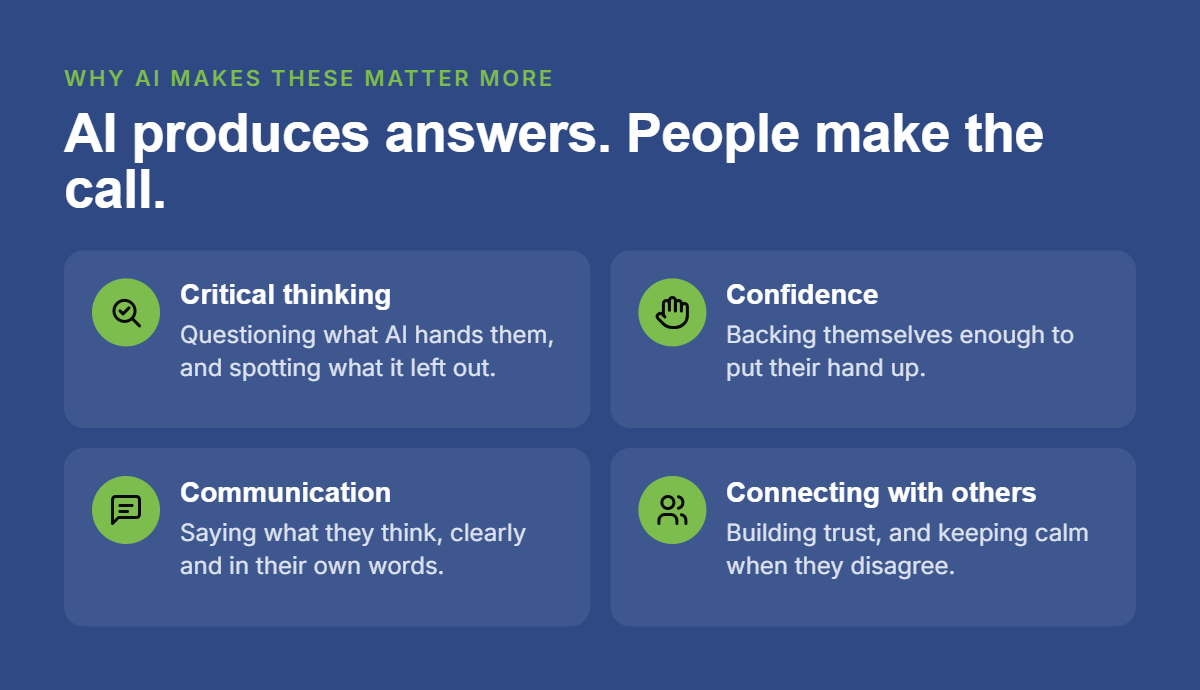
AI is very good at producing answers. The catch is that new starters used to build judgement by doing the routine work, like checking figures and drafting first versions. AI now does much of that. PwC has said its first-year staff are already doing different work from two years ago. Its analysis of US job ads found entry-level roles affected by AI now ask for skills like judgement, once expected only of senior people. So judgement won't build itself on the job the way it used to. It has to be practised on purpose. That's why 4 skills keep coming up:
So can these skills actually be taught?
It's easy to assume some teenagers are just born confident, or naturally good talkers. In practice, all of these skills can be learned, and they grow the way any skill grows: with practice and honest feedback.
The research backs this up. Critical thinking can be taught at any age, and it develops best when students work through real problems and talk them over with someone more experienced. The same goes for social skills.
Confidence and communication work the same way. Dale Carnegie saw this for decades. In his Speak More Effectively guide, he tells the story of Gay Kellogg, who had never made a speech in public and was terrified to try. By the fourth session of his course, she held the room with a story from her own life.

The common thread is practice. Nobody gets confident by reading about confidence. It grows by speaking up, finding out how it landed and having another go. That's good news for parents, because it doesn't depend on personality. It depends on getting enough chances to practise, with honest feedback along the way.
That's the thinking behind Generation.Next. It's a 2-day program in Sydney or Melbourne for students in Years 9 to 12, where they practise these skills out loud with other students. A trainer gives feedback in the moment, so each attempt lands a little better than the last.
The moments they practise for are already in their lives. Holding their nerve when they question a mark with a teacher. Keeping their voice steady at an audition or in a class presentation. Getting a stalled group assignment moving again. Bringing people along as school captain or in a band. Even at home, getting their point across without it turning into an argument. Later, the same skills carry them into a first job. They're the ones employers keep asking for.
Students complete a skills assessment before the program and get a personal report afterwards, so you and your teen can both see the progress. It's built on Dale Carnegie's approach, refined over more than a century and used by more than 9 million people.
AI will change a lot about the first job. What it won't change is who gets hired: people who think for themselves, back themselves and can bring others with them.

Kriza Jo Tanduyan